Expanded Learning Is Always Evolving…and It’s Working
Expanded learning in California is in a season of growth. Through ELO-P, districts are building sustainable, scalable ecosystems. At the ACSA Superintendents’ Symposium, district leaders reminded us that this work is never “done.” It evolves. It improves. It stretches. And when it stays centred on students, it works.
Session at a Glance
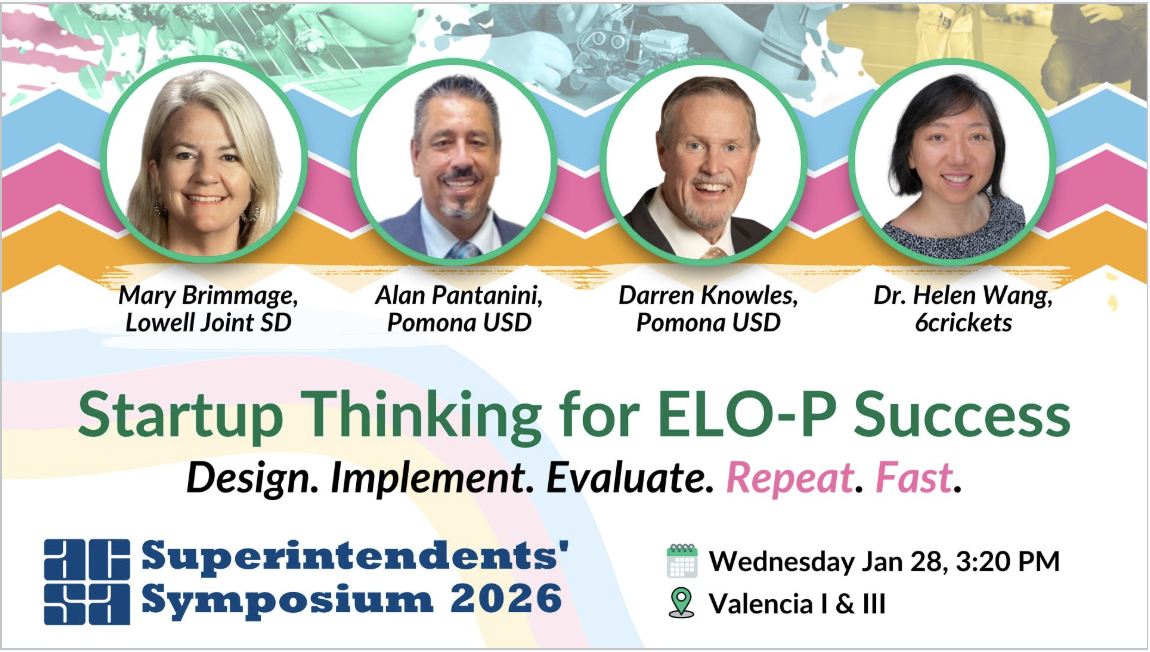
At the 2026 ACSA Superintendents’ Symposium in Indian Wells, Helen Wang, CEO of 6crickets, moderated a panel with some heavy-hitters in expanded learning. The session titled, Start-up Thinking for ELO-P Success: Design. Implement. Evaluate. Repeat. Fast.” included:
- Darren Knowles, Superintendent, Pomona USD
- Alan Pantanini, Director of Expanded Learning, Pomona USD
- Mary Brimmage, Expanded Learning Coordinator, Lowell Joint SD
Helen opened the conversation with a mindset that framed the entire session, “we will never get to perfection but we can continuously improve.”
That spirit of iteration carried through a candid discussion that was practical, honest, and refreshingly real, complete with lessons learned the hard way.
Iteration Over Perfection
If there was a theme that echoed throughout the session, it was this: start, learn, adjust, repeat. As Mary Brimmage reflected, “our first year we used Google Form, and that was quite the learning curve.” Growth rarely begins with polished systems, but it does require intention.
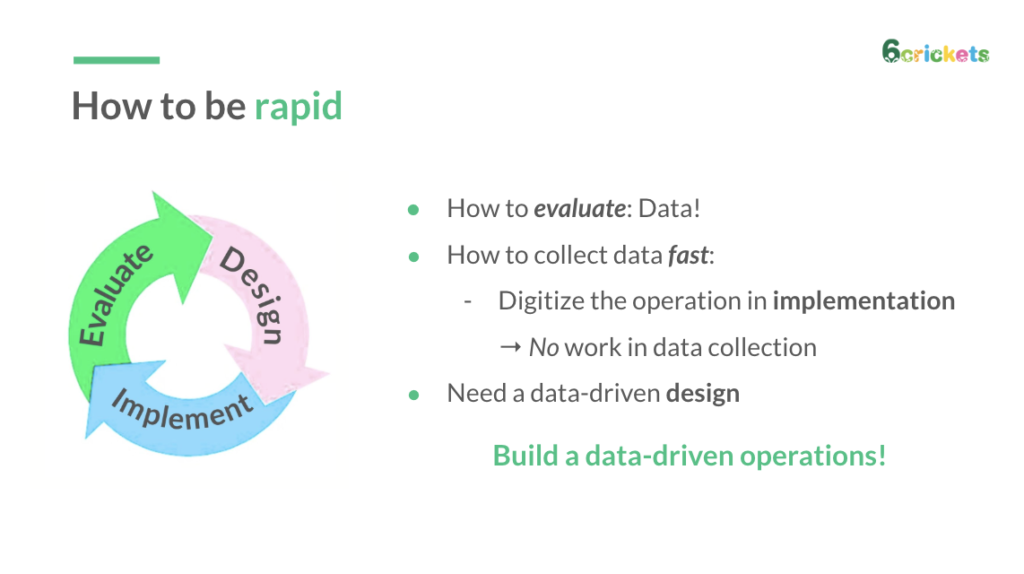
Helen underscored the importance of operational foundations, “if you digitize your operations, the data will always be there.” Digitized systems allow districts to collect meaningful data, evaluate participation trends, and make informed decisions. Continuous improvement isn’t theoretical, it’s built on feedback loops and visibility.
And feedback matters. Mary emphasized this clearly, “we really seek out genuine feedback…how else would we grow?” and “[feedback] is critical to the process of building a program that families need.” Expanded learning programs are becoming more refined each year, not because they started perfect, but because leaders are willing to learn out loud.
Student-Centered by Design
One of the most powerful shifts discussed was the move away from remediation toward enrichment driven by student voice. Darren Knowles reflected on the early days: “When we first started, a lot of it was remedial…the kids weren’t driving it.” Today, that looks very different.
“Now you have this switch where kids are selecting these enrichment opportunities…it’s transformational. Not only for the district but for the kids.”
Mary reinforced that responsiveness, explaining, “As students change and what they want changes, so do our classes.” Programs are evolving alongside students’ interests, passions, and needs.
Alan Pantanini described Pomona’s philosophy clearly, “we wanted to create something that complimented the regular school day and didn’t replicate it. We wanted to support the whole child – not only academically but socially-emotionally, and physically as well.” Districts are designing programs that spark curiosity, build skills, and create joy.
Alan shared, “We wanted to make sure that the experiences we provided didn’t bore our kids,” and added, “We want our kids to go home exhausted but excited about what they’ve learned and wanting to share.” The result speaks for itself, “we’ve grown over 60% in participation rates in 3 years.” When students choose to attend, that’s not compliance, that’s engagement.
Proof It’s Working
The clearest indicator of success? Families and students are responding. “When I talk to the parents, they love [expanded learning],” Darren shared.
Programs are becoming more inclusive and community-centered. As Mary noted, “We want to make a program for both our fee-paying and our UPP students where everyone wants to be there…something that brings together and doesn’t divide.” And perhaps the most telling metric of all, as Alan put it, “We have a lot of fun doing [expanded learning].”
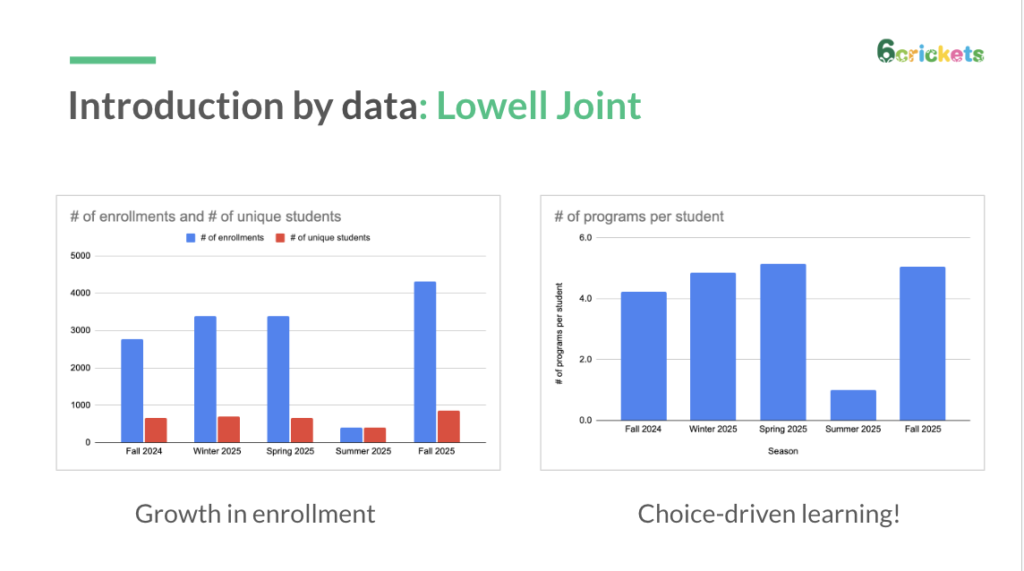
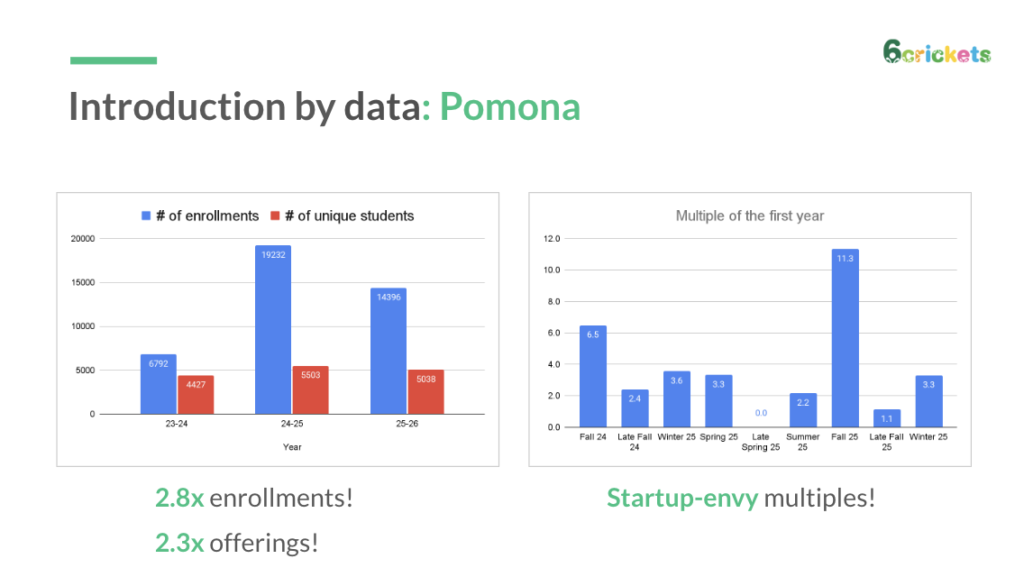
Fun and sustainability are not opposites. When programs are joyful, responsive, and student-centered, participation grows, families engage, and districts build momentum.
The Big Takeaway
Expanded learning is not static. It’s adaptive. It reflects student voice, leans into data, and grows through feedback. It thrives on partnership. As Helen reminded us at the start, perfection is not the goal, progress is. And across California, that progress is visible.
Contact
Interested in exploring how 6crickets can support growth in your Expanded Learning programs? Schedule a conversation!
 info@6crickets.com | [Schedule a conversation]
Yours in Education,
6crickets Team